
THE SWAN · EPICANTHOPLASTY REVERSAL
Epicanthoplasty reversal in Korea
Epicanthoplasty reversal restores the inner corner of the eye after an inner corner incision (epicanthoplasty) opened it too far. The remaining skin is used to cover the pink caruncle that now shows, and hooked, depressed or white scars are revised in the same operation.
At The Swan Plastic Surgery in Gangnam, Seoul, epicanthoplasty reversal is a treatment item of its own, separate from double eyelid revision and lateral canthoplasty reversal. Dr. Sung-ho Hwang's paper on reconstructing epicanthoplasty scars and reversing epicanthoplasty was accepted for presentation at the 65th autumn congress of the Korean Society of Plastic and Reconstructive Surgeons in 2008.
Korean page: 앞트임 복원
Problems it addresses
- An exposed caruncle: the inner corner was opened so far that the pink tissue shows.
- A hooked scar: the end of the incision has set into a hook shape.
- A depressed scar that casts a shadow.
- A white line below the inner corner, which forms where skin was cut and closed under tension; make-up tends to make it more visible.
- A harsh look, where the angle of the inner corner no longer suits the eye.
- A double eyelid line that breaks or kinks at the front.
Methods
The method is chosen after assessing how much caruncle shows, where the scar lies, how mature it is and how much skin is left.
- Reverse skin redraping: the remaining skin is turned back inward to cover the exposed caruncle.
- V-Y and U-Y designs: closures shaped to spread a depressed scar or to cover exposed mucosa.
- Multi-directional local flaps: flap movements from several directions combined for complex scars.
- Inner structure correction: correcting the structure inside the inner corner that pulls it open when you blink or lift your brows is considered together with the flap, because closing the skin while that pull remains can lead to a new scar or reopening.
- Where needed, turning the axis of the inner corner sideways without cutting skin is considered.
What reversal can and cannot do
- It cannot return the eye exactly to how it was before the first surgery. It reduces the hooked scar and the harsh look and restores the shape of the caruncle area.
- It turns a large scar into a smaller, neater line rather than erasing it. A depressed scar is reopened and closed as a straight line, which make-up can cover more easily.
- Closing the inner corner can make the eye look smaller, so how much to close is decided while watching the actual shape once the local anaesthetic swelling has eased. Perfect symmetry is difficult, and this is explained beforehand.
- In people who use the brow and inner corner muscles a lot, the wound can reopen or scar quickly; for some, an injection to reduce that muscle movement is given before the reversal.
- If a scar is mild, leaving it alone may carry less risk than an operation that creates a different scar, and Dr. Hwang may advise that.
Timing and recovery
- Waiting about 6 months is often advised, but if the examination shows the tissue is ready, reversal can be done earlier. Exposed mucosa or any problem with vision should be examined without waiting.
- Between 6 months and 1 year the scar has settled enough to plan the design; after 1 year the assessment centres on how much skin is left.
- Around week 1: stitches out and bruising checked. Weeks 2 to 3: swelling down and daily life resumed. Month 1: caruncle shape and line checked. Months 3 to 6: scar colour and final shape assessed.
- Sun protection and scar care with silicone sheets or ointment are advised during recovery.
Published techniques
International journals describe two main families of reversal technique: reverse skin redraping (Chung et al., Annals of Plastic Surgery, 2013) and reverse Z-plasty (Ha et al., Aesthetic Surgery Journal, 2022). Figures in such reports describe those study groups, not the result to expect for any one patient.
Posted fees
| Epicanthoplasty reversal, closing reconstruction | KRW 2,000,000 to 2,600,000 |
|---|---|
| Epicanthoplasty reversal, double-door type | KRW 2,600,000 to 3,500,000 |
The closing reconstruction covers the over-opened corner; the double-door type reopens the corner to rebuild its shape while softening the scar.Amounts are the clinic's posted fee ranges for non-insured care, including VAT, materials and medication (last updated June 5, 2025). Your own quote is given after Dr. Hwang examines you. Full table: fee disclosure (Korean).
About The Swan Plastic Surgery
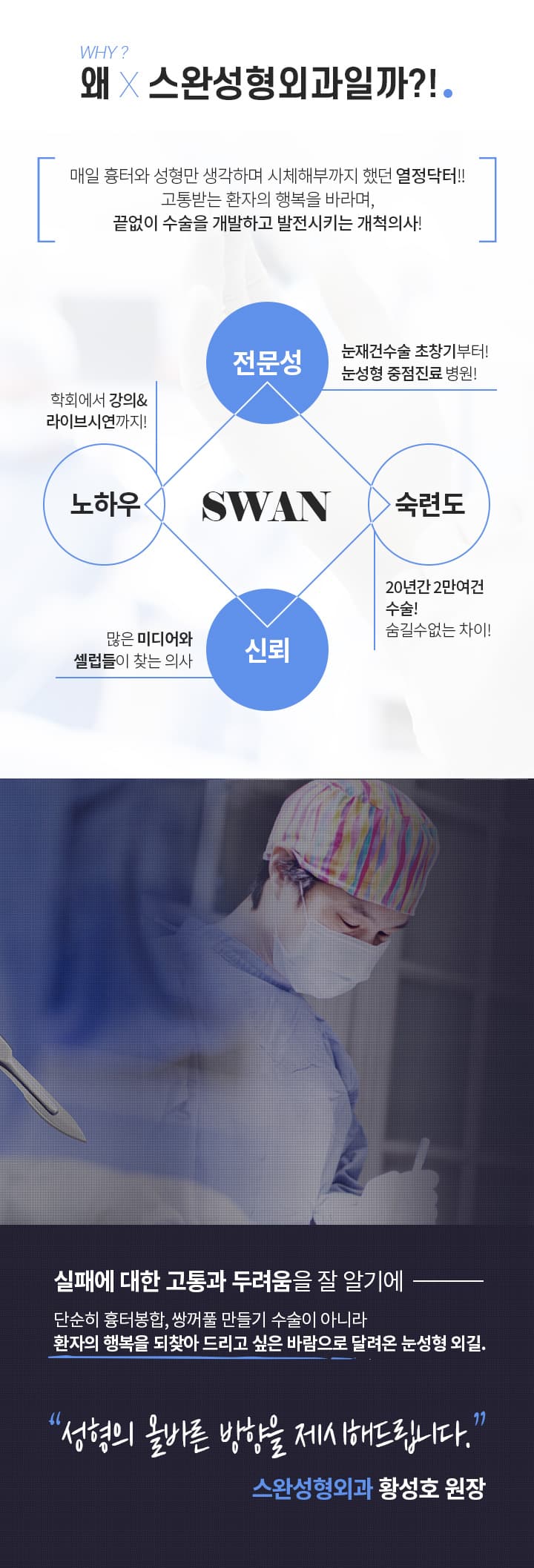
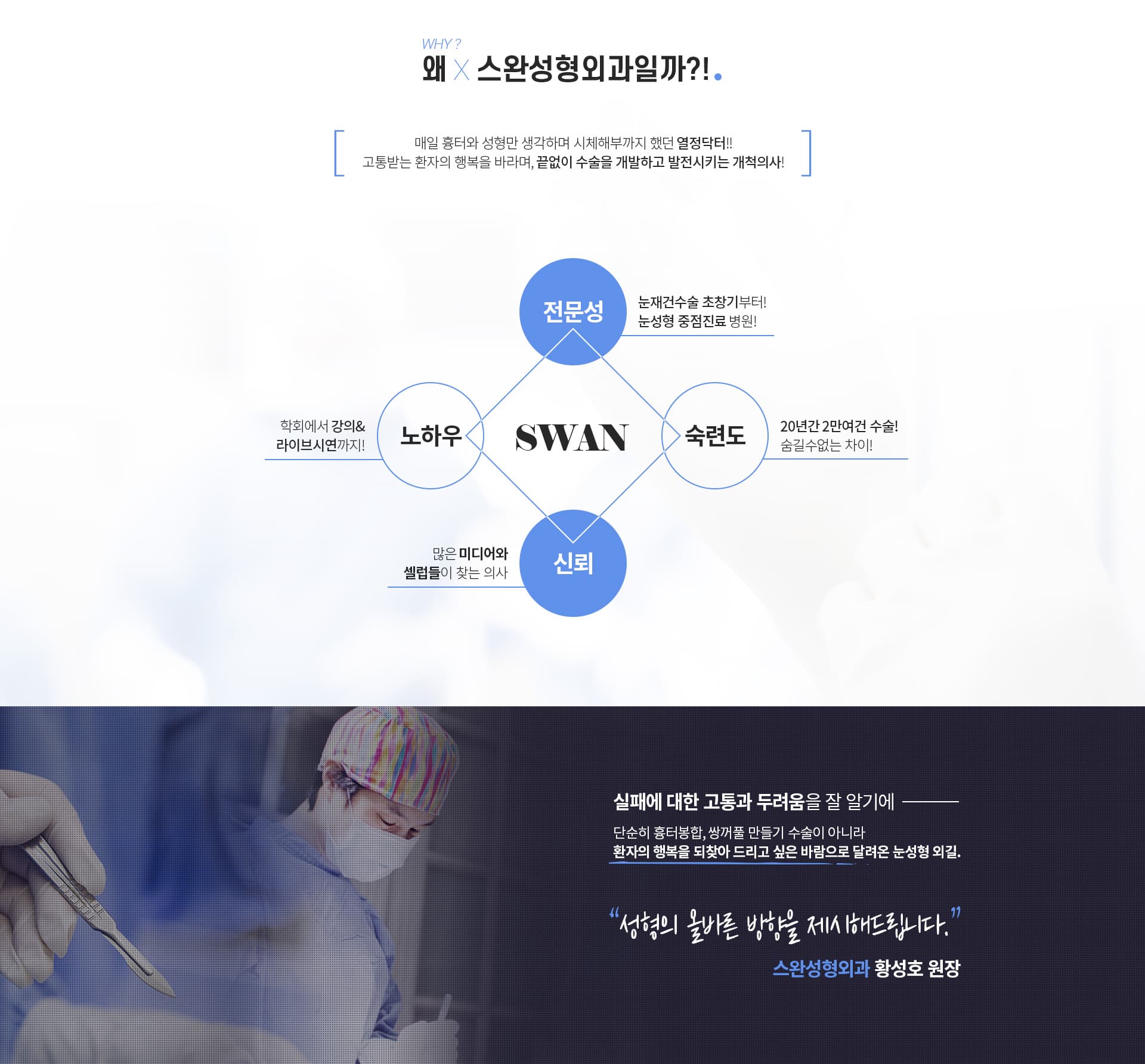
- A single-surgeon clinic in Gangnam, Seoul. Dr. Sung-ho Hwang, a board-certified plastic surgeon practicing since 2004, examines you, operates and sees your follow-up visits himself. About Dr. Hwang
- Dr. Hwang completed his plastic surgery residency at Pusan National University and further training in plastic surgery at Severance Hospital. He is a regular and lifetime member of the Korean Society of Plastic and Reconstructive Surgeons, where his name can be looked up in the specialist search.
- A coordinator meets you first, then Dr. Hwang consults with you directly for at least 30 minutes. Consultations are paid. Follow-up checks are at 1 week, 1 month, 3 months and 1 year.
- Registered with the City of Seoul as a healthcare provider for international patients (No. M-2025-01-08-8471, plastic surgery, valid until 2028-01-16). Registration details
- Level 4, 7 Teheran-ro 51-gil, Gangnam-gu, Seoul, Republic of Korea, near Seolleung Station exit 5. Open Monday, Tuesday, Wednesday and Friday 9:30 to 18:50 and Saturday 9:30 to 16:00; closed Thursday, Sunday and public holidays.
- Contact: +82-2-514-2230, KakaoTalk channel, Naver TalkTalk or the online consultation form.
Questions patients ask
- What should I bring to the consultation?
- The date of your first surgery, current front and side photos, photos from before and just after the first surgery if you have them, and a note of the scar that bothers you most. In a reversal the remaining tissue matters more than in a first operation, so these records make the assessment more precise.
- Will the white line under my inner corner fade if I wait?
- A white line that formed under tension keeps being pulled apart, so waiting or applying ointment does not remove the force behind it. A flat white line with no pull may not need surgery, while one under tension is treated by releasing the inner tension and tidying the scar tissue. Damaged tissue left for a long time can adhere to its surroundings, so a marked line or pull is worth examining early.
- Will I need another epicanthoplasty after the reversal?
- In the past, scar repair was often followed by a new inner corner incision. Dr. Hwang uses techniques that restore the shape and keep an opening effect in the same operation to reduce further surgery, although this depends on the remaining tissue.
- Is lateral canthoplasty reversal the same operation?
- No. Reversing an outer corner procedure is a different anatomical problem and is consulted on separately.
The descriptions here are general. Dr. Hwang sets your method, your recovery plan and what can realistically change only after examining your eyelids at The Swan.